
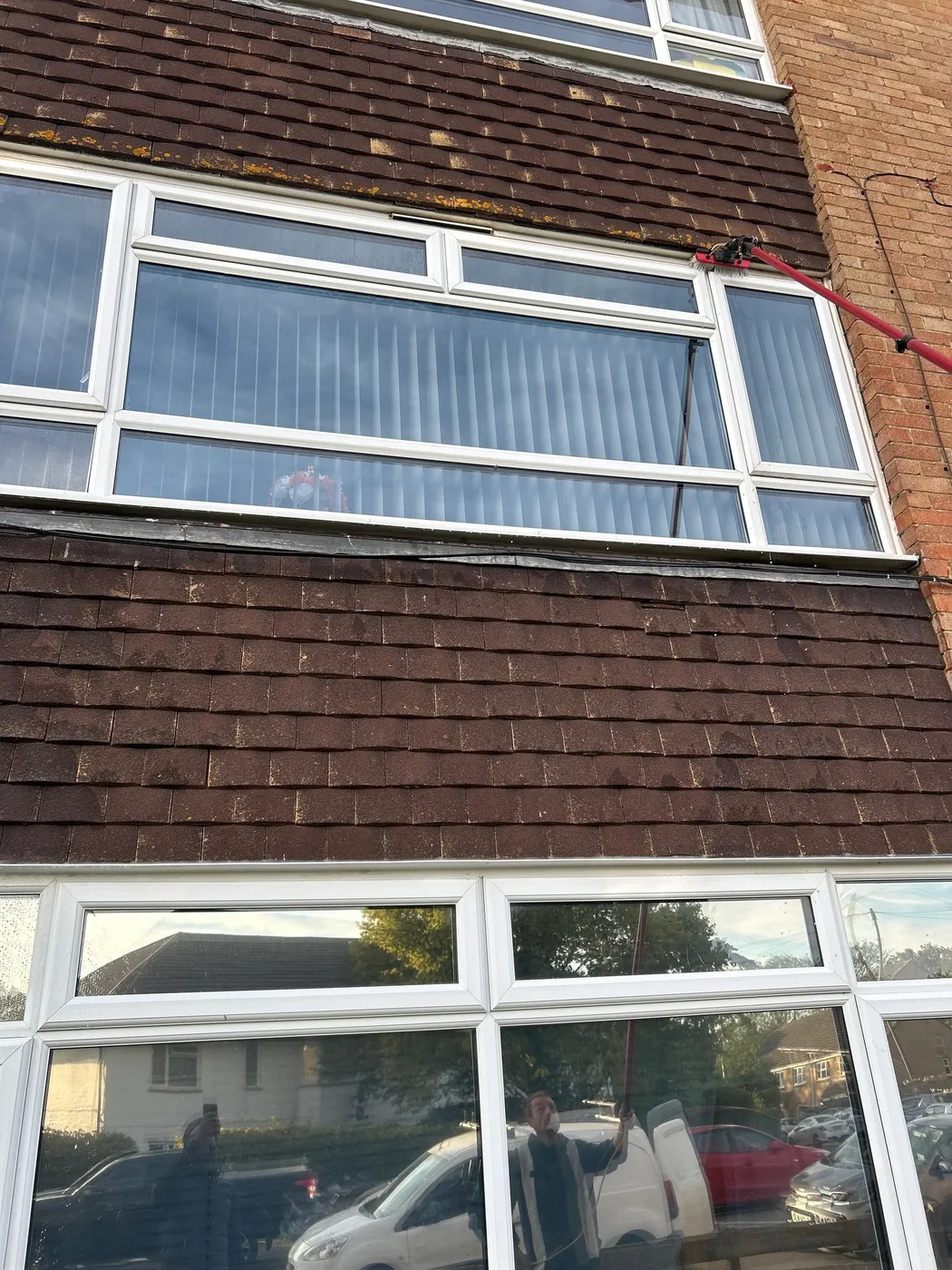
Yes, within limits, and the limits are the whole answer. K Rend, the render manufacturer, permits a pressure washer on its own maintenance page, with clean water and a low concentration of mild detergent. It sets the condition immediately: fan application, not high power. So both the nozzle and the pressure matter. Neither deals with the algae. K Rend sends you to a biocide or algaecide for that, so rinsing a wall moves the growth rather than killing it. Below is what the manufacturers publish, surface by surface.
Can you jet wash render, according to K Rend?
It is widely repeated that render manufacturers say never to pressure wash render. That is not what K Rend publishes. Its maintenance page allows a pressure washer outright, then sets the condition in the same sentence: fan application, not high power, because very high pressure washers can damage the render surface. Read that wording. Very high pressure washers, not pressure washers.
We still soft wash render rather than pressure wash it, for two reasons. A fan at low pressure does nothing to the algae. And you have to know exactly which render system you are standing in front of before you point a machine at it.
Two more instructions get skipped. K Rend says to carefully clean the render surface, in a controlled fashion, working from top to bottom. Its aftercare guide calls the method a mild detergent wash, followed by a gentle power-wash. Gentle is their word. It handles the green separately: to remove algae from affected substrates, use a biocide or algaecide such as K Rend Algae Clean. Water is for the dirt, a biocide is for the growth.
A second manufacturer puts numbers on it
Wetherby Wall Systems reaches the same conclusion, with figures. Its manual for the insulated silicone render system says a pressure wash can be used on the face of the render where staining has occurred. Then come the limits. The pressure washer should be set at 100 bar maximum, and used no closer than 1 metre from the render. A sample panel should always be completed first. Those figures are Wetherby's, for Wetherby's own system, not a setting for every wall.
Why a jet nozzle takes the colour off
Thin coat silicone render is why this matters. The colour is not paint sitting on something thick. The coloured coat is the render. K Rend's data sheet says Silicone TC 10, 15 and 30 are applied to the thickness of the largest grain size, and gives those grains as 1.0mm, 1.5mm and 3.0mm. So on a common TC 15 finish, the whole coloured layer is about a millimetre and a half thick. The smoother TC 05, largest grain 0.5mm, is applied differently, as two tight coats by hand or by spray machine.
Hold a jet nozzle close to that and you are removing part of it, not cleaning it. A wet wall hides everything, so it shows only once the wall dries:
- Bands or stripes that dried lighter than the wall around them, following the lance.
- Patches that feel rougher than the rest, where the grain has been opened up.
- Colour that cannot be touched in, because it goes all the way through the coat.
Patching thin coat render to match an elevation is a rendering job, not a cleaning one, and we do not do rendering. On cracks, be fair about cause and effect: a pressure washer will usually find an existing one rather than create it. Wetherby says any cracks exceeding 0.2mm must be investigated to assess the cause and repaired as appropriate.
Why the green comes back if you only blast it
Pressure moves what you can see. It does not kill what made it. That is why a wall cleaned in April is green again by winter. Historic Environment Scotland, writing about historic stone rather than modern render, sets out the mechanism. Spores of some species may survive the cleaning process, and re-growth of green algae may even accelerate following cleaning. It adds that stonecleaning is also likely to roughen the surface and increase surface porosity, creating even more favourable conditions for biological growth than before.
That guidance is scoped to stone, so we will not pretend it is a statement about render. But the mechanism is not fussy about the material. A rougher, more open surface holds water, and anything holding water grows. The Brick Development Association gives the same order for brickwork. Remove any loose growth, apply an algaecide to kill off the remaining growths, then take the dead vegetation off by careful pressure washing. Kill it first, then remove it. That is the order we set out for paving in how do you remove black spots and lichen from a patio or driveway?
Locally it is usually the north facing wall that goes first, and plenty of houses across Surrey and West Sussex sit under trees. Our soft washing page explains how we approach it.
Is render cleaning worth paying for if the algae is not damaging anything?
This part rarely gets said out loud. K Rend's aftercare guide says the presence of algae will not adversely affect the long term performance of the render. Historic Environment Scotland says something similar about masonry: in general, algal growth on masonry is superficial and does not penetrate or cause physical damage. It gives one exception: a thick algal layer sitting in the joints between stones can encourage woody plants that may be damaging.
So render cleaning is a cosmetic job, and that is a good reason to do it. But you are buying how it looks, not rescuing the building. If you are told the green is eating your render, that is a worry the manufacturer does not share.
There is one case where the green tells you something useful. Historic Environment Scotland advises inspecting the building to see whether new growth is a symptom of a maintenance problem, such as blocked guttering or drainage issues. Resolving those should cause the existing growths to die off. So if one dark green stripe runs down an otherwise clean wall, look up first. That is usually a gutter overflowing in the same spot, and clearing the gutter is the thing to sort out. Our gutter clearing page covers that side of it.
So what we actually do, and how it changes by surface
The water does the least important part of the work. We clear anything loose, apply a biocide and let it work, then rinse at low pressure with a wide fan, top to bottom, the way K Rend describes. A soft wash keeps working after we leave. Some of the colour comes back while we are there. The rest weathers off over the following days and weeks, though how much and how fast varies wall by wall. How long it then stays clear depends on shade, trees and which way the wall faces.
A test patch comes first, as the manufacturers ask. Dulux Trade is clear that its fungicidal wash will only be effective on surface growths. Where old growths have been trapped between previous coats, all existing coatings need to be removed. If the black sits under the paint, no wash reaches it. The same Dulux sheet also cuts against the way soft washing is usually pitched. On badly affected areas, it says, the use of high pressure water-hosing may be necessary to remove all organic growth completely. A soft wash is the right default, not the answer to everything.
Render is only part of a house, and the answer changes with the material.
- Pebbledash and roughcast: the stones are bedded into the mortar coat behind them. A close jet can knock them out, and cleaning will not put them back. We keep the lance well back and test a small area first.
- Brickwork: the Brick Development Association says pressure washing of older brickwork is never recommended without a detailed survey of its condition. It says never to use pressure washers on lime mortar. It is very easy to blast off the surface of sand faced bricks. Where a washer is used, it wants fan type sprays at the lowest pressure, at least 100mm wide at the brickwork.
- Timber cladding and weatherboarding: the Timber Decking and Cladding Association writes about decks, not cladding. Its 2016 guidelines say not to use the lance too close, and to set the pressure to the minimum level. Blasted softwood raises and furs up, and that rough texture stays once the wood dries.
- PVC and composite cladding: this tolerates the most. Freefoam, which manufactures PVC cladding, says you can use a pressure washer, adjusted to half power, to keep it clean and free from dirt or stains. Even so, green in the shiplap joints is growth, not dirt, so it still wants treating.
- Conservatory roofs and glazing bars: we clean these, but never with a pressure washer. ConservatoryLand's maintenance guide says pressure washers should not be used on self cleaning roof glass. Its do-not list adds high pressure or steam cleaners, and walking on conservatory roofs. So it is a low pressure soft wash, with the gutters cleared by hand.
- Roofs: same principle, different detail, and we have written that one up separately.
Two of those are covered elsewhere on the site. Our window, cladding and PVC cleaning page covers the cladding and glazing side. For roofs we set out the whole argument in soft washing or pressure washing a roof: which one is safe?
If your render has gone green, the useful questions are simple. Which way does the wall face, is anything overhanging it, and is there a gutter above the worst of it. We will look at that, do a test patch, and tell you straight if a wall does not need doing. Our before and after page shows earlier jobs either side of a clean.
Frequently asked questions
Can you jet wash render?
Yes, within limits. K Rend's maintenance page says the surface can be cleaned using a pressure washer with clean water and a low concentration of mild detergent. It then sets the condition: fan application, not high power, because very high pressure washers can damage the render surface. It will still not deal with the algae, which needs a biocide. Those instructions are K Rend's, for K Rend's own render, so the system on the wall has to be identified first.
Do render manufacturers say never to pressure wash render?
Not the two we checked. K Rend allows a pressure washer on fan application at low power. Wetherby allows a pressure wash on its insulated silicone render system at 100 bar maximum, no closer than 1 metre, with a sample panel completed first. Both fence it in tightly. Neither bans it.
Why does render go green again so soon after it has been cleaned?
Water removes the growth you can see and leaves the spores behind. Historic Environment Scotland, writing about historic stone, says spores of some species may survive the cleaning process, and that re-growth of green algae may even accelerate afterwards. A biocide is what kills it, so we treat first and rinse gently.
Is green algae damaging my render?
Probably not. K Rend's aftercare guide says the presence of algae will not adversely affect the long term performance of the render. Historic Environment Scotland says that in general, algal growth on masonry is superficial and does not penetrate or cause physical damage. It gives one exception: a thick algal layer sitting in the joints can encourage woody plants that may be damaging.
Can painted render and painted masonry be soft washed?
Usually, but the result is less predictable, so we test a patch first. Dulux Trade points out that a fungicidal wash will only be effective on surface growths. Where old growths have been trapped between previous coats, all existing coatings need removing. If the staining sits under the paint, cleaning improves the wall without fully clearing it.