
Most UK roof panels keep themselves reasonably clean, because rain runs the dirt off any array pitched at roughly 15 degrees or more. Cleaning matters for what rain cannot shift: bird droppings, tree sap, lichen creeping in from the frames, and a gradual film of dust and pollen. The Energy Saving Trust suggests a clean every 12 to 18 months.
That is the honest headline, and it is not the answer a cleaning company is supposed to give. Here is the detail, including the things you should never do to a panel and the reason we clean them from the ground.
Why rain does most of the work
Panel glass is smooth and the array sits at an angle, so rain sheets off it and takes loose dust with it. E.ON Next puts a figure on it: the UK has plenty of rain to keep most solar installations clean year round, as long as they are mounted at an angle of 15 degrees or more. The Energy Saving Trust says much the same, that for panels on a roof the rain does a good job thanks to the angle they sit at, and that ground mounted panels may need cleaning more regularly.
That angle is the whole point. A steep, open, rain-washed roof largely looks after itself. A near-flat array, a ground mounted one, or a roof tucked under trees does not.
What rain cannot shift
- Bird droppings, which bake onto the glass and do not rinse off.
- Tree sap, blossom and leaf litter from anything overhanging the roof.
- Lichen and moss working in from the frames and the tiles around the array.
- A slow build-up of dust and pollen through a dry spell, or traffic film near a busy road.
The reason a small mark matters more than you would expect is hard shading. Cells in a panel are wired in series, so a solid, opaque blob on one cell drags on far more than its size suggests. Solar Guide makes the same point: even a small amount of hard shading can reduce output dramatically. An even film of dust is a mild, gradual loss. One well-placed dropping is not.
Solar Guide also notes something we see constantly: a television aerial hanging over an array gives birds somewhere to perch directly above the panels. If you have an aerial, a chimney or a ridge above your array, that is usually where the mess comes from.
How often, honestly
The published advice genuinely varies, and it is worth seeing the spread rather than being given one confident number:
- The Energy Saving Trust says clean every 12 to 18 months, more often if the panels are exposed to dust, trees or bird droppings.
- E.ON Next says you should not need to clean them at all, because they are designed to be self-cleaning.
- Heatable puts it at once or twice a year in the UK, and points you to your manufacturer manual for what your particular panels need.
From doing the work, shade and birds are what decide it. An array under trees or below an aerial is worth looking at yearly. A clean, steep, open roof away from anything overhanging can go considerably longer. If your generation figures have drifted down over a couple of seasons and the weather does not explain it, that is a better prompt than any calendar.
Why we will not pressure wash a solar panel
This is a pressure washing company telling you to keep a pressure washer away from something. The Energy Saving Trust is direct: you should avoid using a high-pressure power washer to clean your solar panels, because power washers can interfere with seals and wiring, which can lead to water damage. E.ON Next says the same, that powerful jet washers can cause damage to the surface of the panels.
The rest of the list matters just as much:
- Do not stand on the panels. The Energy Saving Trust warns they are not designed to support the weight of a person and could crack or break completely, and that the coatings can be slippery.
- Do not use washing up liquid or bleach. The Energy Saving Trust advises against washing up liquid because it can leave a film that helps dust build up, and E.ON Next warns that harsh chemicals can damage the protective coating.
- Do not use anything abrasive. Soft brushes and soft cloths only, so the glass is not scratched.
- Do not clean them hot. The Energy Saving Trust points out that water evaporates quickly off hot panels and leaves streaks and residue, so cool weather is better.
- Do not touch the wiring. If you spot damaged cabling, stop and report it to your installer, because it is an electric shock hazard.
On isolating the system, the advice differs slightly by source. The Energy Saving Trust says to turn your system off before you begin and to check your manual if you are unsure how. E.ON Next goes further and says to have a trained solar professional disconnect the panels from electricity and from any battery before starting.
The height problem
Most domestic arrays sit on a pitched roof, which puts this squarely into working at height. HSE guidance on the Work at Height Regulations 2005 exists to prevent death and injury caused by a fall from height, and requires that work is properly planned, supervised and carried out by competent people, using the right type of equipment. The homeowner version from the Energy Saving Trust is simpler: clean from the ground if you can, because it is always safer to avoid working at heights if you do not have the right training or equipment. Heatable advises not cleaning roof mounted panels yourself at all unless you are properly trained and equipped.
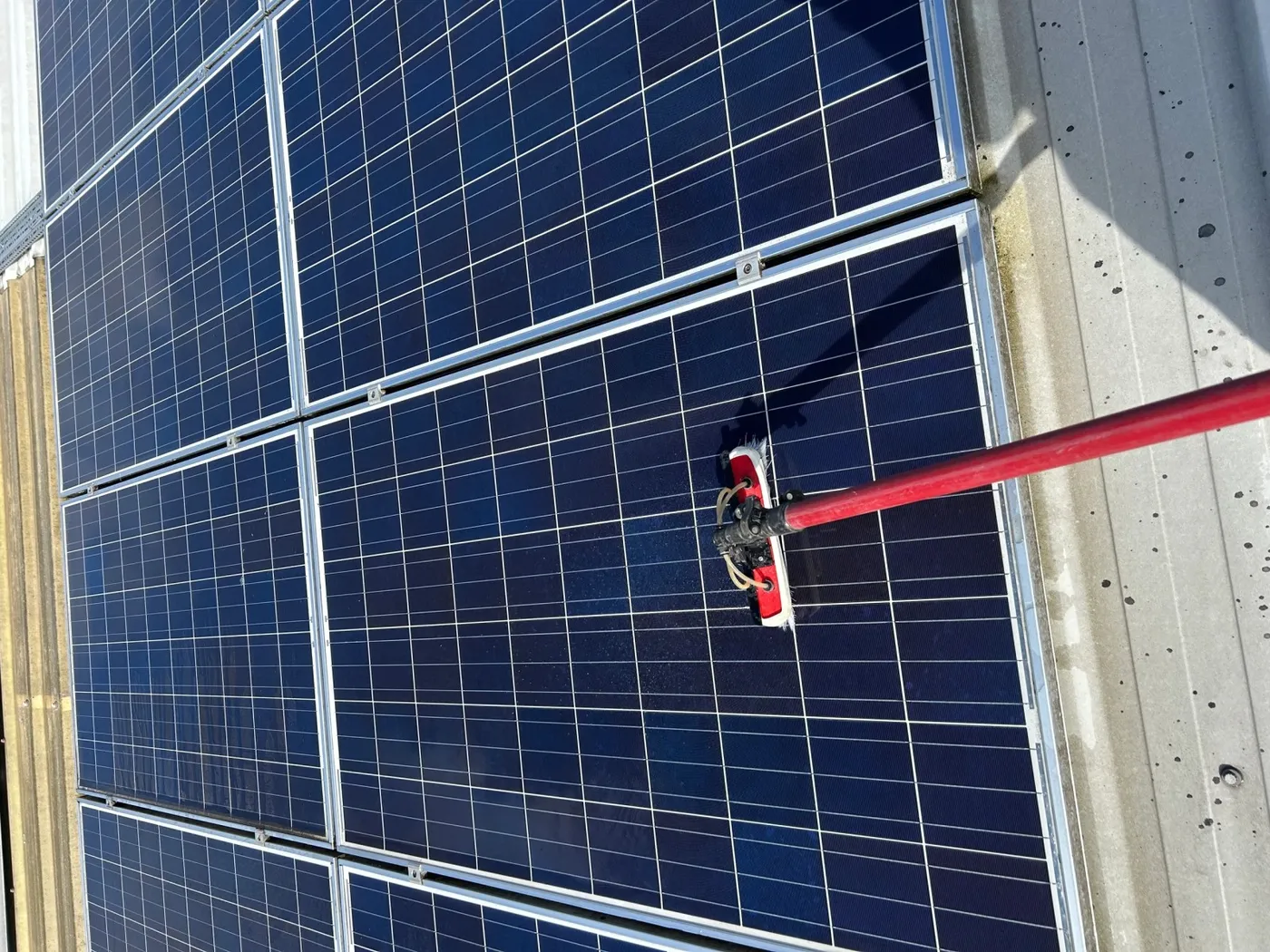
That is why we clean panels with a water fed pole from the ground wherever the roof allows: a soft brush head on an extending pole, nobody up on the tiles, and nothing standing on the glass. While we are there we will usually look at the gutters as well, because an array with moss and droppings on it tends to sit above gutters in a similar state. Our solar panel cleaning and gutter clearing pages cover both.
So is it worth having done?
Cleaning cannot make panels generate more than they were built to. It removes a loss, and whether that loss exists depends on your roof. If your array sits under trees or below a perch, or you have watched output drift without a weather explanation, a clean is worth doing. If it is steep, open and rain-washed, it may not be, and we would rather tell you that than sell you a visit you do not need. On cost, the Energy Saving Trust puts professional solar panel cleaning at somewhere between £20 and £200 depending on the size of the system, access and how much cleaning is needed. That is a general UK market range rather than a quote for your roof. Get in touch and we will give you a price for what you actually have.
Frequently asked questions
Do solar panels really need cleaning in the UK?
Often less than people think. E.ON Next says UK rain keeps most installations clean year round, as long as they are mounted at an angle of 15 degrees or more. The Energy Saving Trust still suggests a clean every 12 to 18 months, and more often if the panels are exposed to dust, trees or bird droppings. Shade and birds are what really decide it.
Can you pressure wash solar panels?
No. The Energy Saving Trust warns that power washers can interfere with the seals and wiring on solar panels and lead to water damage, and E.ON Next says jet washers can damage the panel surface. Panels are cleaned with a soft brush and a gentle flow of water, which is why we use a water fed pole from the ground rather than a lance.
Does cleaning solar panels increase output?
It removes a loss rather than adding performance. Dust and dirt cut the light reaching the cells, and a solid mark such as a bird dropping causes hard shading, which Solar Guide notes can reduce output dramatically for its size. If an array is already clean, cleaning it again will not do much.
Can I clean my own solar panels?
From the ground, with a soft brush and plain water, many people can. On a pitched roof it is a different job. The Energy Saving Trust advises cleaning from the ground where possible because it is always safer to avoid working at heights without the right training and equipment, and Heatable advises against doing roof mounted panels yourself.
How much does professional solar panel cleaning cost?
The Energy Saving Trust puts it at somewhere between £20 and £200 across the UK, depending on the size of the system, access and how much cleaning is required. That is a general market range rather than a quote. Get in touch and we will price your roof properly.