
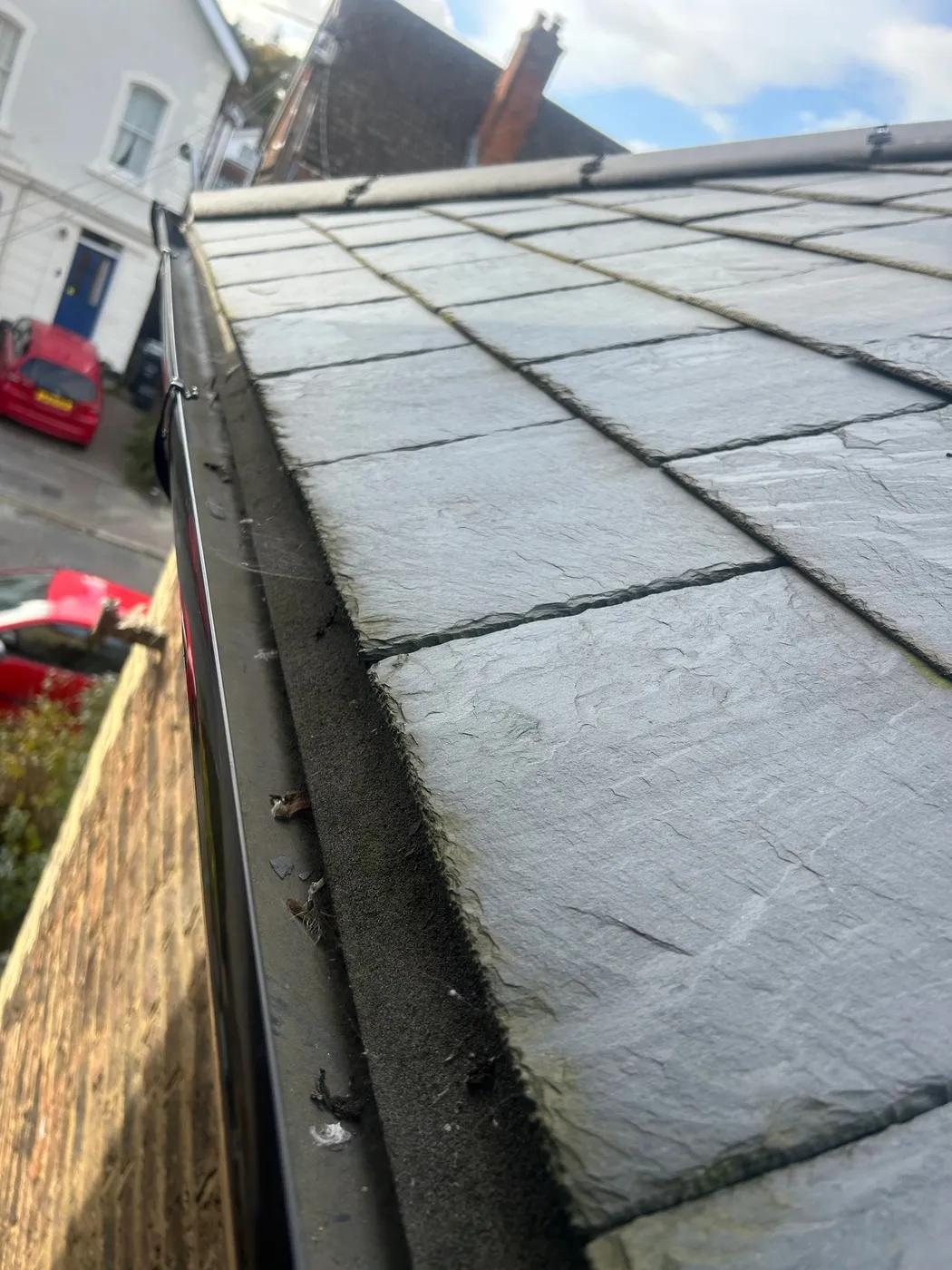
Once a year clears most houses, and twice is worth it where there are trees over the roof or heavy moss on the tiles above. What decides the number is not the calendar, it is what sits above the gutter. Leave them and the usual order is overflow in heavy rain, staining down the wall, then damp, which is the expensive end. Below is what the published guidance says, and it does not agree with itself.
What the guidance actually says, and why it does not agree
Search this and you will be told twice a year, spring and autumn, almost everywhere, and that figure has a real source. Gutter cleaning and gutter clearing are the same job, so the answer is the same whichever you searched for. Eurocell, a UK building products manufacturer, says on its gutter cleaning page that most homeowners should clean their gutters at least twice a year, typically in spring and autumn. The honest part is that the same page then says something different further down: the general recommendation is around once a year, or twice if you live near trees. Both sit on one page from one manufacturer, which is worth knowing before you take twice a year as settled.
The other sources spread further. Historic England, in its maintenance checklist for older homes, says to inspect and clear any debris or blockages after heavy leaf fall, at least every autumn and preferably more often. Marley, a UK roof tile manufacturer, says most experts recommend roof maintenance checks twice a year, once in the autumn and once in the spring, with all eaves and gutters cleared of debris as part of them.
So the useful answer is a range rather than a rule. Once a year clears most houses, and twice is worth it under trees or below a mossy roof. Our gutter clearing page covers what the job itself involves.
On timing, Eurocell is plain that late autumn is the best time, to remove the leaves that have fallen. Clearing under a big deciduous tree before the leaves have finished falling usually means doing it again in November. Try not to let it slide into January either, because Eurocell notes that trapped water can freeze in winter and cause gutters to expand and break.
What sits above the gutter decides the number
A gutter does not fill on a schedule. It fills with whatever the roof above it sheds, so tree cover, roof pitch and which way the slope faces matter more than the month. Across Surrey and West Sussex tree cover is nearly always what settles it. The wooded lanes around Dorking and Oxted fill gutters far faster than an open estate a few miles away.
Evergreens are the ones that catch people out. The Royal Horticultural Society notes that evergreen plants also shed their old leaves regularly, and that the leaves are usually lost gradually throughout the year. It gives holly hedges as its example. So a house beside conifers or a big holly hedge never gets a neat autumn peak, it gets a steady trickle instead.
What pushes a particular house up the range:
- Mature deciduous trees overhanging the roof. Eurocell goes as far as quarterly where a home is surrounded by trees. It does not say why, and we will not put words in its mouth, but on the ground the reason is plain enough: material keeps coming down, and not only in autumn.
- Heavy moss on the tiles, which washes down into the gutter whether there are trees or not. Historic England's checklist asks whether there is a lot of moss, because it could block gutters and pipes or stop water running off the roof.
- A shallow roof pitch. Eurocell says a flatter roof may collect more debris, leading to more frequent clogs.
- A north facing slope. Marley notes that moss and lichen are more likely there, because it is in shade more than other aspects of the roof.
- Branches touching the roof. Marley's advice is to trim overhanging branches back to reduce shade.
If your tiles are visibly green, the gutters are collecting that growth continuously, and that is the part most people miss. Our roof cleaning page covers the moss itself, and our guide to soft washing versus pressure washing a roof explains why the method matters.
What goes wrong if you leave them
Problems arrive in a predictable order, and most are visible from your own garden long before anyone needs a ladder. Roughly as we see them:
- Overflow in heavy rain, water going over the front lip instead of away down the downpipe. Eurocell describes blocked flow spilling over the sides and pooling around the house.
- Streaked staining down the wall below. Historic England asks whether there are signs of staining or algae growth, or any washed-out mortar joints, on the wall behind the pipe.
- Sagging, which Eurocell says may signify a buildup of heavy debris, though it names improper installation as the other cause.
- Damp on the walls, inside and out. Eurocell calls a wet patch on the outside of a property under a leaking gutter the telltale sign.
- Water seeping in under the roof covering, which Eurocell links to rot and leaks. The least common, and the most serious.
The damp end of that list is where the money goes. The Property Care Association, a UK trade body for damp and timber specialists, says penetrating damp may be nothing more than the appearance of a damp patch, but that left unchecked the consequences can be very severe, costly and difficult to repair. It names blocked guttering and defective fall pipes as a common cause of water getting into a building.
That is the whole argument for bothering. A blocked gutter is a small problem, and damp in a wall is a big one that pulls in trades and disruption clearing never does. Historic England puts it plainly in its maintenance tips: once you see a problem, act quickly to prevent damage from escalating and the cost of repairing it mounting. We will not claim that clear gutters prevent damp, because the sources do not claim it either. They say blocked ones are a common route in.
A dirty streak left down render, cladding or painted masonry is a separate job from the clearing. Our soft washing page covers how those walls get cleaned without blasting them.
How to check your own gutters from the ground
The best test costs nothing and needs no ladder. RICS, the professional body for chartered surveyors, puts it well in its consumer guide to damp and mould: anyone can investigate and look for problems, so you could go outside in the rain and see whether your gutters are overflowing, and if something does not look right, it usually is not right. Historic England says much the same, advising you to inspect while it is raining and note any leakages.
A slow walk round covers the rest. Look at the wall behind each downpipe for staining, algae or washed-out mortar joints. Look along the front lip for anything green sprouting over the edge. Historic England also suggests binoculars for high level areas where safe access is not available, which is useful and almost nobody does it. The Property Care Association adds a warning worth repeating: ivy and other climbing plants may hide many of these faults.
When an overflowing gutter is not a blockage
A gutter can overflow with nothing blocking it, and that changes what you should expect from a clear-out. Historic England's checklist asks whether the gutters slope correctly towards the outlets, because a run that has dropped out of fall pools and spills however clean it is. Its guidance on rainwater systems adds two more causes: a system failing to shed water effectively away from the building because of inappropriate layout or detailing, and one overwhelmed during heavy downpours because the system capacity is insufficient. For both it says upgrades or alterations may be necessary.
The same guidance notes that with valley, box or parapet gutters, a visual inspection from ground level may not suffice, and high level access for a closer assessment may be needed. If your house has a valley or sits behind a parapet, what you can see from the lawn may not be the whole story.
Plainly, then: clearing will not fix a gutter that has dropped, split or worked loose. We clear gutters and downpipes. We do not repair, replace, re-hang or re-seal them, and we do not fit gutter guards. If something is wrong with the gutter itself you get told and shown where it is, because it is worth a proper look from the right trade.
This is work at height, and here is what a clear-out involves
A gutter run is only reachable from a ladder, a tower or a pole system, which makes this work at height. Falls from a height are the largest single cause of workplace deaths in Great Britain, according to the Health and Safety Executive's provisional figures for 2025/26. Those are workplace accidents reported under RIDDOR rather than homeowners on their own ladders, so it is not a like for like comparison. It is simply why this job is worth a thought before anyone goes up.
What a clear-out involves at our end is straightforward. The downpipes get cleared as well as the gutters, because a clear gutter feeding a blocked downpipe still overflows. Water gets run through afterwards so the whole run can be watched rather than assumed. Debris comes out into bags instead of over a border, and anything spotted gets reported back to you. Access gets looked at before anything is quoted, because a two storey rear elevation above a conservatory is not a bungalow.
Our before and after photos show the standard of the work. If you already know what you need, tell us what is above your gutters when you ask for a quote.
Frequently asked questions
Is twice a year really necessary?
Eurocell's gutter page says at least twice a year in one place and around once a year in another. Historic England says to clear after heavy leaf fall, at least every autumn and preferably more often. Once a year clears most houses in Surrey and West Sussex, and twice is worth it under trees or below a mossy roof.
When in autumn should gutters be cleaned?
Late autumn, once the leaves have actually finished falling. Eurocell says plainly that this is the best time, to remove the leaves that have fallen. Going up before a big deciduous tree has finished usually means doing it a second time in November.
My gutters were cleared and they still overflow. Why?
Because clearing only fixes a blockage, and not every overflow is one. Historic England's checklist asks whether the gutter slopes correctly towards the outlet, since a run that has dropped out of fall will pool and spill however clean it is. Its rainwater systems guidance also covers a system overwhelmed during heavy downpours, or one failing to shed water away from the building because of its layout or detailing. Those are repair matters rather than clearing ones.
Do gutter guards mean the gutters never need clearing?
We do not fit gutter guards and we do not remove them as part of a clear-out, so this is not something we sell either way. We did not find independent evidence on how well they perform, so we are not going to tell you they work, and we are not going to tell you they do not.
Can I clear my own gutters safely?
Plenty of people do, and a bungalow with firm level ground either side is a very different job to a two storey rear elevation. Ladders on soft or sloping ground, and anything over a conservatory, are where it gets risky. If you are not comfortable up there, do not go up. Get in touch and tell us what is above your gutters.