
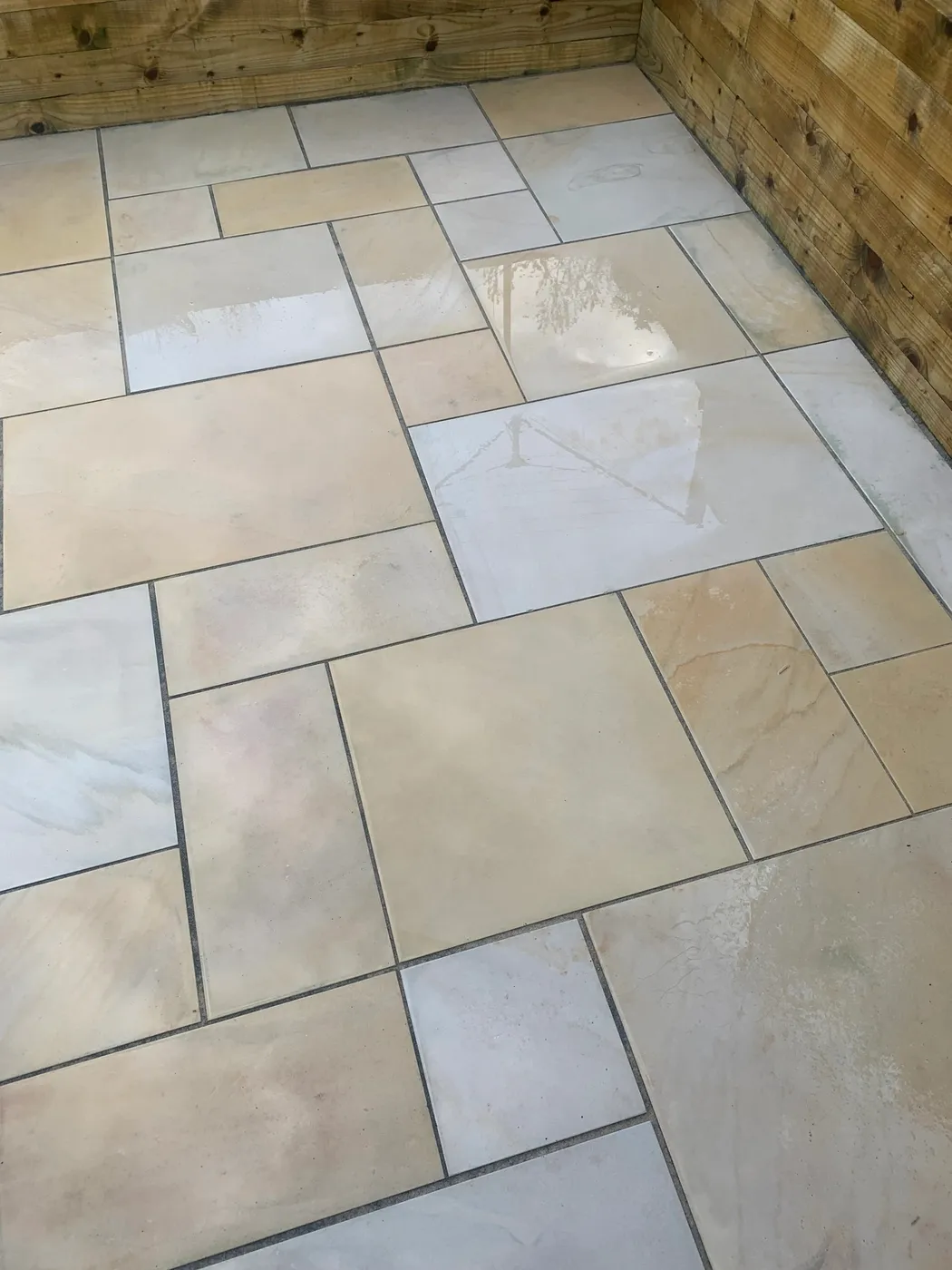
Not always, and plenty of paving is better left alone. Marshalls, one of the largest UK paving manufacturers, states plainly that as a company it believes it is not necessary to seal its block paving. Sealing genuinely earns its keep on porous imported sandstone and on pattern imprinted concrete. On tarmac and resin it does nothing useful at all.
It is a fair question to ask once a patio has just been cleaned and is looking its best. Here is where sealing helps, where it is a waste of money, what it will not do, and how long you have to wait after a clean before anything goes on the surface.
The myth that every patio needs sealing
McMonagle Stone, a natural stone manufacturer, is refreshingly direct about this. It says the problem stems from the widely spread urban myth that all natural stone paving needs a paving sealant, and adds that there is more than a suspicion that the myth is promoted by sealant manufacturers. Its honest summary is that some paving needs a sealant some of the time, not all paving all of the time.
Pavingexpert, the long-running UK paving reference site, takes a similar line on block paving. Its guide says: "We are not big fans of these sealants for normal, domestic applications, although we fully appreciate their benefits and endorse their use on public works, high traffic areas, fuel stations etc." In other words, sealing a filling station forecourt and sealing a suburban driveway are not the same decision.
What a sealer actually does
A decent sealer is doing real work. Pavingexpert lists what a quality polyurethane sealant offers on block paving: it repels oils and paints including light fuel oils, prevents staining and efflorescence, virtually eliminates weeds, and bonds the jointing sand to reduce loss through erosion. That last point is the one most homeowners have never heard and is often the strongest argument for it on a driveway.
What it does not do matters just as much:
- It does not kill black spot lichen or stop it returning. That is a living growth rooted into the stone and it needs a biocide, which our <a href="/services/soft-washing/">soft washing</a> page explains.
- It does not fix a sunken sub-base, loose blocks or a failing edge restraint.
- It is not a substitute for cleaning. Sealing over a dirty surface locks the dirt in under a film you then have to strip off.
- It is not permanent. Sealers wear, particularly on a drive, and need redoing.
Material by material
- Imported sandstone and other porous natural stone: the strongest case for sealing. These stones drink up moisture, and McMonagle Stone points out that some imported stones simply do not fare well in a damp, cool climate. An impregnating sealer slows staining on a pale patio that marks easily.
- Concrete block paving: optional rather than necessary. Pavingexpert endorses it on high traffic and commercial surfaces but is not keen on it for ordinary domestic drives. Binding the jointing sand is the practical benefit if you do go ahead.
- Pattern imprinted concrete: pavingexpert lists this among the surfaces to seal, because the sealer forms part of the finish rather than being an optional extra. It wears off and needs renewing.
- Porcelain: dense and close to non-porous already, so there is very little for a sealer to do on the tile itself. The grout joints are a different matter.
- Tarmac, macadam and resin: pavingexpert lists these as not needing a sealant. If someone is trying to sell you a sealer for a resin drive, ask why.
When to seal after a clean, and when not to
Applying a sealer too soon is the classic mistake, and it is the reason most sealing jobs go wrong. Pavingexpert is specific: sealants should not be applied to any pavement that is less than 3 months old, and not before all traces of efflorescence have disappeared. After a power wash, the surface needs to dry right through, and it allows at least three days in summer and up to two weeks in winter for that. It also says to make sure there is no chance of rain over the next 24 hours and that the pavement is completely dry.
So a sensible checklist before anyone opens a tin:
- The paving is at least three months old and the white efflorescence bloom has finished appearing.
- It has been cleaned and then given days of dry weather, not hours.
- A run of dry, mild weather is forecast, with no rain expected for at least 24 hours.
- The joints have been re-sanded first, because part of what the sealer does is bind that sand in place.
- The product has been tested on a spare slab or a hidden corner and you are happy with how it looks.
The risks worth knowing about
Pavingexpert warns that sealants can have a dramatic effect on the appearance of a pavement, and that effect may well be permanent and irreversible. It also notes that some people have found out too late that a bargain sealant picked up at a DIY shed had irreversibly altered the appearance of their paving. Alongside that, certain sealers can trap moisture in the substrate and lead to efflorescence or damage, and some finishes end up slippery when wet, which is not what you want on a patio you walk across in winter.
None of that means sealing is a bad idea. It means it is a decision worth making deliberately, on the right surface, with a tested product, on a surface that is genuinely dry.
The honest answer for most homes
For a standard block paved drive across Surrey, Sussex and Kent, a thorough clean and proper re-sanding does most of the work, and sealing is a choice rather than a requirement. For a porous imported sandstone patio, especially a pale one in a shaded garden, sealing is worth considering once the stone is clean, treated and properly dry. Either way the order matters: clean first, treat any growth, re-sand, let it dry, then decide about sealing. Our patio cleaning and driveway cleaning pages explain how we approach the cleaning side.
To be plain about where we fit in: we clean and treat paving. Sealing is a separate job with its own products, timings and risks, so this guide is here to help you decide whether you want it done at all, not to sell it to you.
Frequently asked questions
Does Marshalls recommend sealing block paving?
No. Marshalls states in its customer service FAQs that as a company it believes it is not necessary to seal its block paving. Its reasoning is that a sealant has to go onto a surface that is clean, dry and free from dust, and that sealants may affect the appearance of the units and wear unevenly. It gives the same answer for its permeable Priora range, adding that some sealants may clog the joints.
How long after cleaning can a driveway be sealed?
Long enough for it to dry right through, not just on the surface. Pavingexpert allows at least three days in summer and up to two weeks in winter after a power wash, and says the paving must be completely dry with no chance of rain over the next 24 hours. Sealing damp paving is the most common cause of problems.
Will sealing stop black spots coming back?
No. Black spot is a lichen rooted into the stone, and a sealer does not kill it. The growth has to be treated with a biocide first, and the surface cleaned, before any sealer is considered. Sealing over it simply locks the marks in.
Can sealing change the colour of my paving?
Yes. Pavingexpert warns that sealants can have a dramatic effect on the appearance of a pavement and that the effect may well be permanent and irreversible. Some give a wet look or a sheen that is not to everyone's taste. Test any product on a spare slab or a hidden corner first.
Does resin or tarmac need sealing?
Pavingexpert lists macadam, asphalt and resin as surfaces that do not need a sealant. They are not porous in the way natural stone is, so there is little for a sealer to do.